Then Baileys Beads Meet The Diamond Ring
Baily’s beads and the diamond ring effect explained: lunar topography, timing, photography, parallax, and the emotional climax of partial phases.
Curtain-raisers of the eclipse
If you have ever stood in the path of a total solar eclipse, you know that the experience is not a single moment but a sequence of wonders. The hours of anticipation, the creeping partial phases, the strange light, the drop in temperature, the 360-degree sunset — all of it builds toward the main event. But in the final seconds before totality, and again in the first seconds after, the sky delivers two of its most spectacular tricks: Baileys Beads and the Diamond Ring effect. These are the curtain-raisers of the eclipse, the final flourish before the corona appears, and they are often the moments that leave observers breathless.
Baileys Beads
Baileys Beads are named after Francis Baily, a British astronomer who described them in detail in 1836, though they had been observed and marvelled at for centuries before. The phenomenon occurs because the Moon is not a perfectly smooth sphere. Its edge, or limb, is rugged with mountains, valleys, and craters. As the Moon moves across the face of the Sun, the last sliver of sunlight does not disappear all at once. Instead, it streams through the low points along the lunar limb, creating a string of brilliant beads of light. These beads shimmer and dance for a few seconds, then vanish one by one as the Moon continues its journey.
The effect is delicate and fleeting. The beads may appear as a handful of points of light, or as a nearly complete necklace around the edge of the Moon. They are intensely bright, far brighter than the corona that will soon appear, and they stand out starkly against the dark silhouette of the Moon. For observers, the appearance of Baileys Beads is a signal: totality is imminent. It is the universe's way of saying, “Get ready. This is about to happen.”
Lunar topography made visible
The beads are not just beautiful; they are also informative. Their pattern reveals the topography of the lunar limb at that particular point. Because the Moon's edge is irregular, the beads appear and disappear in an irregular sequence. Observers with cameras often try to capture them, though the exposure settings that work for the beads are very different from those needed for the corona . Many eclipse chasers learn, sometimes too late, that the few seconds of Baileys Beads are not enough to adjust settings, take a photo, and still look up with their own eyes. The wise observer watches first and photographs second.
The Diamond Ring effect
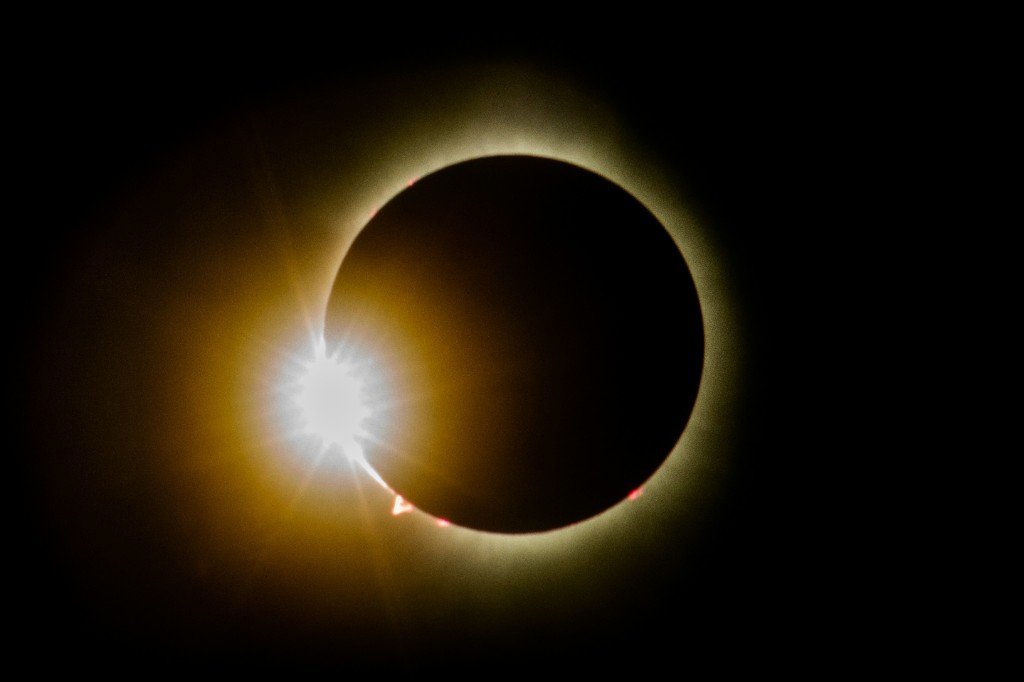
As the last bead fades, or just before the first bead reappears, another phenomenon takes center stage: the Diamond Ring effect. This occurs when a single point of sunlight shines brilliantly from behind the edge of the Moon, surrounded by the faint glow of the inner corona. The result looks uncannily like a cosmic engagement ring: a dazzling diamond set in a pearly band. It is one of the most iconic images in eclipse photography, and for good reason. The contrast between the intense point of light and the soft glow of the corona is striking, and the effect is unmistakable even to first-time observers.
The Diamond Ring is often the moment when the crowd reacts most strongly. There is a collective gasp, followed by applause, cheers, or sometimes tears. It is the visual climax of the partial phases, the final punctuation mark before the sentence of daylight ends and the paragraph of totality begins. For many, it is the most photogenic moment of the eclipse, though again, the wise observer remembers to put the camera down and simply look.
Timing, geometry, and parallax
The two effects are closely related. Baileys Beads are the result of sunlight streaming through multiple valleys along the lunar limb. The Diamond Ring is what happens when only one such valley remains, or when the first one opens as totality ends. The difference is largely one of timing and geometry. If the Moon's limb at the point of contact is particularly rugged, the beads may be more numerous and dramatic. If the limb is smoother, the transition to the Diamond Ring may be more abrupt. Every eclipse is different, and every viewing location along the path sees a slightly different sequence.
One of the fascinating aspects of Baileys Beads and the Diamond Ring is that they are not the same for every observer. Two people standing a few kilometres apart may see slightly different patterns of beads, because the alignment of the Sun, Moon, and observer is not identical. This parallax effect means that the beads and the Diamond Ring are local phenomena, unique to each viewing site. It is a reminder that an eclipse is not a single event but a family of events, each slightly different depending on where you stand.
Baileys Beads
Diamond Ring
A dream and a challenge for photographers
For photographers, Baileys Beads and the Diamond Ring are both a dream and a challenge. The beads are extremely bright, requiring fast shutter speeds and careful exposure. The Diamond Ring is slightly less demanding, but still requires a balance between capturing the brilliance of the “diamond” and the subtlety of the “ring” of corona. Many eclipse photographers use bracketing, taking multiple exposures in quick succession to ensure that at least one image captures the full range of light. Others accept that no single photo can do justice to the moment, and focus instead on experiencing it directly. Our Eclipse Photography guide covers exposure planning — but never at the cost of missing the live view.
Observer tips
- Watch the beads with your own eyes before reaching for a camera
- Use fast shutter speeds for beads; bracket exposures for the Diamond Ring
- Expect different bead patterns from observers even a few kilometres apart
- Put filters back on the instant the Diamond Ring reappears after totality
Exclamation points of totality
The emotional impact of these effects is often underestimated. People travel thousands of miles to see a total eclipse, and they may remember the corona, the darkness, the stars at midday. But for many, the most vivid memory is the instant when the Diamond Ring appears. It is a moment of clarity, of beauty, of connection. It is the point at which the abstract idea of an eclipse becomes concrete, when the predictions and the maps and the planning dissolve into a single, undeniable reality: the Sun is being covered by the Moon, and you are here to see it.
Baileys Beads and the Diamond Ring are also reminders of the precision of the cosmic dance. The Moon must be exactly the right distance from Earth for total eclipses to occur. The alignment must be exact. The timing must be perfect. A small shift in any of these parameters, and the beads would not appear, or the ring would not form, or the eclipse would be annular rather than total. We live in a time and place where these conditions are met, and that is no small thing.
In the end, Baileys Beads and the Diamond Ring are more than just optical phenomena. They are the punctuation marks of the eclipse, the exclamation points that frame the sentence of totality. They are the moments that make observers look up and forget everything else. They are the reason why people chase eclipses across continents, why they camp in fields, why they stand in the cold and the dark, waiting for the sky to change. And when the beads appear, and the ring forms, and the world holds its breath for a moment, they know: it was worth it.