The Awe And Splendor Of Totality
What it feels like to stand in the path of totality: partial phases, the 360-degree sunset, the corona, diamond ring, and why eclipse chasers keep coming back.
An experience that defies description
There are moments in life that defy description, experiences so profound that they alter your perception of the world. Witnessing a total solar eclipse is one of them. It is not merely a celestial event; it is a visceral, emotional, and almost spiritual encounter with the mechanics of the universe. People who have stood in the path of totality often struggle to find words adequate to the experience, resorting instead to terms like “transcendent,” “humbling,” or simply “unforgettable.”
The journey to totality
The journey to totality begins long before the Moon's shadow touches the Earth. It starts with anticipation, a collective tension that builds over months or years of planning. Eclipse chasers converge on a narrow strip of land, sometimes in the middle of a desert, sometimes in a bustling city, sometimes on a remote island. They bring telescopes, cameras, solar filters, and a sense of purpose. As the appointed hour approaches, the atmosphere shifts. There is a palpable excitement, a shared understanding that something extraordinary is about to happen.
Planning the trip
The real cost
Partial phases and a changing world
The partial phases begin subtly. The Sun, that constant companion of our days, starts to diminish. A small notch appears on its edge, growing steadily as the Moon moves across its face. The light does not fade in the way it does at sunset; instead, it takes on an eerie quality, as if the world is being viewed through a filter. Shadows become sharper, more defined. The temperature drops noticeably, and a cool breeze often sweeps through the viewing area, as if nature itself is preparing for the main event.
As the eclipse progresses, the environment responds in ways that feel almost uncanny. Birds begin to settle, their daytime songs giving way to the quiet of evening. Insects may start to chirp, confused by the approaching darkness. Flowers that open in daylight may begin to close. The sky, once a brilliant blue, deepens to a strange twilight hue. Along the horizon, a band of orange and pink persists, a 360-degree sunset that encircles the observers. It is a surreal moment, one that feels both familiar and utterly alien.
Shadow bands and the final seconds
Then comes the final approach to totality. The Sun is reduced to a slender crescent, its light dimming rapidly. The air grows cooler still, and the sense of anticipation reaches a peak. In the last seconds before totality, shadow bands may appear — rippling waves of light and dark that dance across the ground, caused by atmospheric turbulence refracting the thin sliver of sunlight. These are fleeting and elusive, often visible only to those who know to look for them.
And then — totality
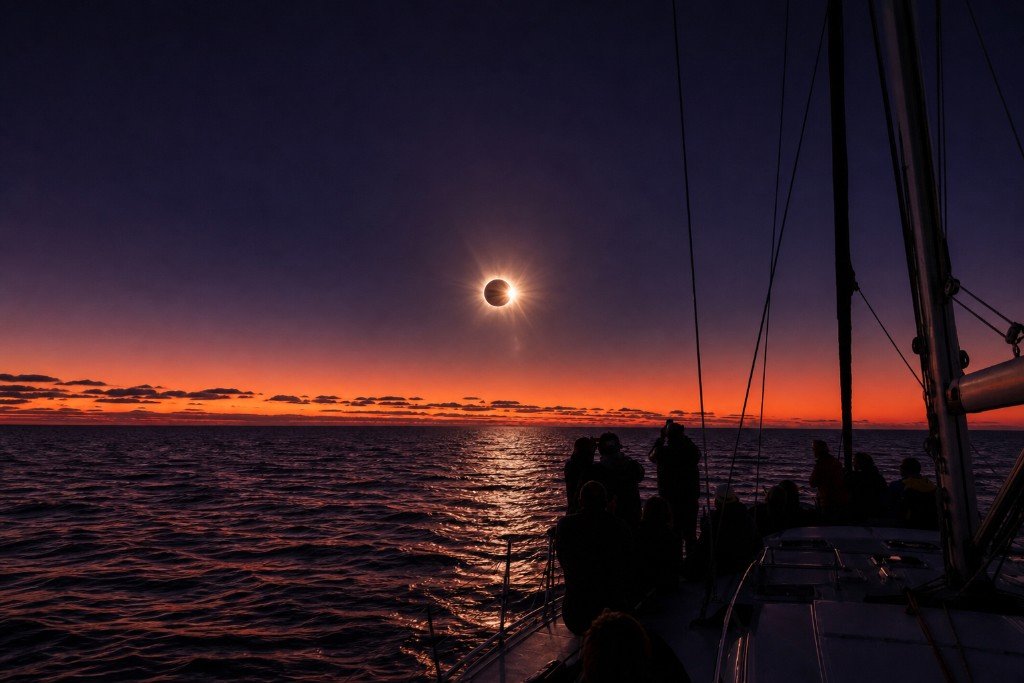
The moment the Moon completely covers the Sun, the world transforms. Day becomes night in an instant. The sky darkens to a deep indigo, and stars and planets become visible. The Sun's corona — the outer atmosphere, a tenuous halo of plasma — erupts into view, a luminous crown of pearly white light surrounding the black disk of the Moon. It is ethereal, delicate, and utterly unlike anything else in nature. The corona is not static; it shimmers and shifts, with streamers and loops extending outward into space. No photograph, no video, no description can fully capture its beauty. It must be seen. For more on what you are looking at, read The Ghostly and Elusive Solar Corona .
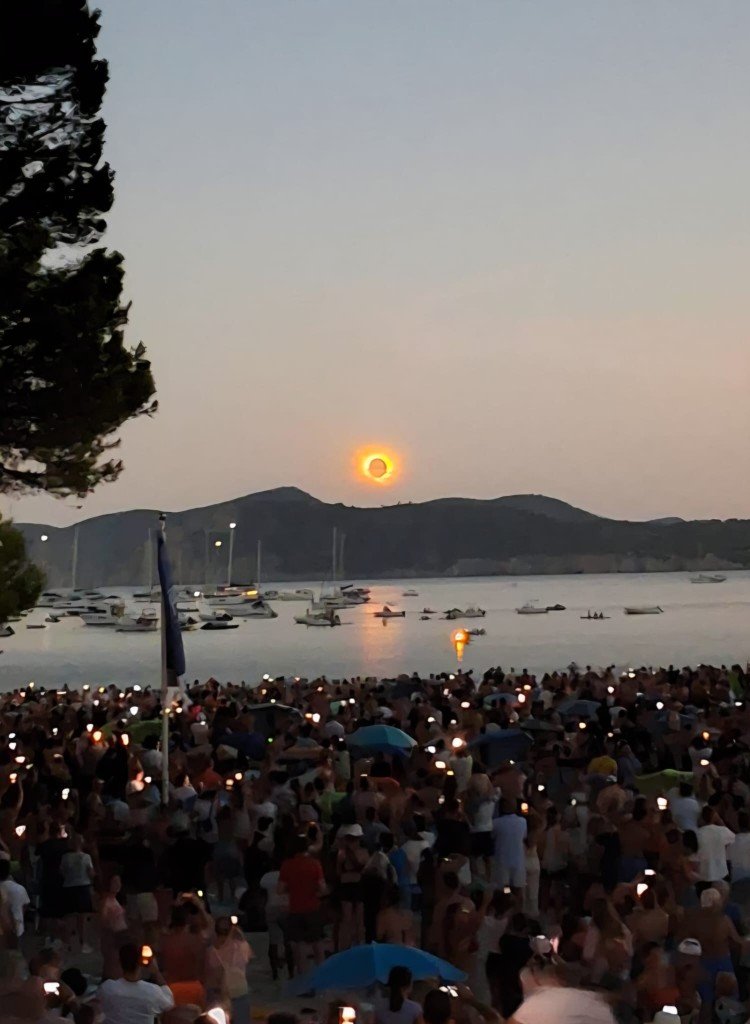
For those in the path of totality, the experience is overwhelming. There is often a collective gasp, followed by silence, then applause, cheers, or tears. Some observers stand motionless, transfixed. Others rush to adjust cameras or telescopes, though many find themselves simply staring, unable to look away. The emotional impact is profound. People report feeling small, humbled, connected to something vast and ancient. It is a reminder that we live on a planet in motion, orbiting a star, sharing space with a Moon that, by an extraordinary cosmic coincidence, is almost exactly the right size and distance to cover the Sun perfectly.
Brief, and gone
Totality is brief. The maximum duration for any given eclipse is just over seven minutes, and most are shorter. For many observers, it lasts only two or three minutes. Yet those minutes feel elongated, as if time itself has slowed. When the first sliver of sunlight reappears — the “diamond ring” effect — the world snaps back to reality. The corona vanishes. The light intensifies rapidly. Birds resume their songs. The temperature begins to climb. The partial phases continue, but the magic of totality has passed. For a deeper look at beads and ring at both ends of totality, see Baileys Beads Meet the Diamond Ring .
If you hope to photograph the event without missing it, read our Eclipse Photography guide — but many veterans advise experiencing your first totality with your eyes, not only through a lens.
What lingers
What lingers is the memory. People who have witnessed totality often describe it as a pivot point in their lives, a moment that reshaped their understanding of their place in the cosmos. It is not uncommon for eclipse chasers to become addicted, travelling across continents to stand in the path of totality again and again. Each eclipse is unique: the corona changes shape with the solar cycle, the viewing location offers different landscapes and conditions, and the personal context evolves. But the core experience remains the same: a few minutes of darkness that illuminate something deep within the human spirit.
Signs of the approaching totality
- Sharper, more defined shadows and an eerie quality to daylight
- Cooling air and birds falling quiet
- Deep twilight sky with a 360-degree sunset on the horizon
- Slender crescent Sun and fleeting shadow bands on the ground
- Instant darkness, visible stars, and the pearly corona
- Diamond ring as totality ends — solar filters back on immediately
A shared human moment
The awe and splendor of totality lie not only in the visual spectacle but in the shared human experience. Strangers become companions, united by the pursuit of a fleeting moment. Scientists and amateurs stand side by side, each with their own reasons for being there. Children and elders alike look up, witnessing the same sight that has inspired wonder in humans for thousands of years. In an age of digital distraction and constant connectivity, totality demands presence. It is a reminder that some things cannot be streamed, downloaded, or simulated. They must be lived.
For those fortunate enough to witness a total solar eclipse, the experience is indelible. It is a reminder of the beauty and mystery of the universe, and of the extraordinary luck that allows us, on this particular planet, to see the Sun and Moon align so perfectly. Totality is not just an astronomical event. It is a moment of connection — to the cosmos, to nature, and to each other. And once you have stood in the shadow of the Moon and looked up at the corona, you will never forget it.