The Art And Science Of Eclipse Prediction
How solar eclipse prediction evolved from ancient cycle-finding to Kepler, Halley, Bessel, and today’s computational maps of the Moon’s shadow on Earth.
A striking achievement
The prediction of solar eclipses and the mapping of their paths across the Earth's surface represent one of the most striking achievements in the history of astronomy. What began as an ancient art of pattern recognition evolved, over thousands of years, into an exact science capable of forecasting eclipses to within a second. This transformation reflects not only advances in mathematics and observation, but also a profound shift in how humans understood their place in the cosmos.
The ancient art: cycles and omens
For much of human history, these events were interpreted as supernatural omens — signs of disaster, divine displeasure, or upheaval. Yet even in antiquity, careful observers noticed that they were not random. By around 600 BCE, Babylonian priest-mathematicians had compiled extensive records of past alignments on clay tablets, searching for repeating patterns. They discovered that such events tend to recur in cycles, the most famous of which is the Saros cycle: approximately 6,585 days, or just over 18 years. After one Saros, the Sun, Moon, and Earth return to nearly the same relative geometry, and a similar alignment occurs.
This early work was more art than science. It relied on empirical rules of thumb rather than a physical understanding of why they happened. Nevertheless, it allowed ancient astronomers to predict when one might occur, even if they could not yet say where on Earth it would be visible or how long totality would last. In the Graeco-Roman world, Ptolemy's Almagest (2nd century CE) provided mathematical tools to compute alignments, marking the first explicit technical treatment of prediction in ancient astronomy. For the mechanics behind the Saros, see The Saros Cycle .
The scientific turn: from when to where
The real breakthrough came with the shift from asking when an alignment would occur to asking where its shadow would fall. This required not only accurate tables of lunar and solar motion but also a method for projecting the Moon's shadow onto the curved surface of the Earth.
In the 17th century, Johannes Kepler introduced a “projection method” that allowed astronomers to calculate visibility for specific locations. Yet the first attempts to draw the actual shadow path on a terrestrial map appeared only in the Age of Enlightenment. The earliest known solar eclipse map was created in 1654 by the German professor Erhard Weigel and his student Andreas Günther Seiffart, published on the day before the total eclipse of August 12, 1654. This map depicted the shadow's track across Europe and is widely regarded as the first such representation.
Later, in 1664, the French astronomer Jean-Dominique Cassini is said to have constructed the path of a solar eclipse visible in Ferrara on a terrestrial map, though evidence for this remains fragmentary. The earliest confirmed eclipse map by Cassini dates to 1700, showing the path of the September 23, 1699 eclipse.
1654 — Weigel & Seiffart
1699 / 1700 — Cassini
Halley and the birth of predictive mapping
The figure most often associated with the first scientifically based and accurate predictive eclipse map is Edmond Halley. In 1715, ahead of the total solar eclipse of April 22, Halley published a broadsheet that included a map of the Moon's shadow passing over England and southern Scotland. His map showed the northern and southern limits of the path of totality and invited observers to record the duration of darkness so that future predictions could be refined.
Halley's 1715 map is sometimes called the first “modern” eclipse map because it combined accurate prediction with clear geographic representation. It was accurate to within about four minutes of time — a remarkable achievement for the era. Halley went on to produce similar maps for the 1724 eclipse, cementing his reputation as a pioneer of predictive astronomy. His work marked a turning point: these phenomena were no longer just celestial events to be observed; they were events that could be forecast and mapped with precision.
The mechanics of prediction
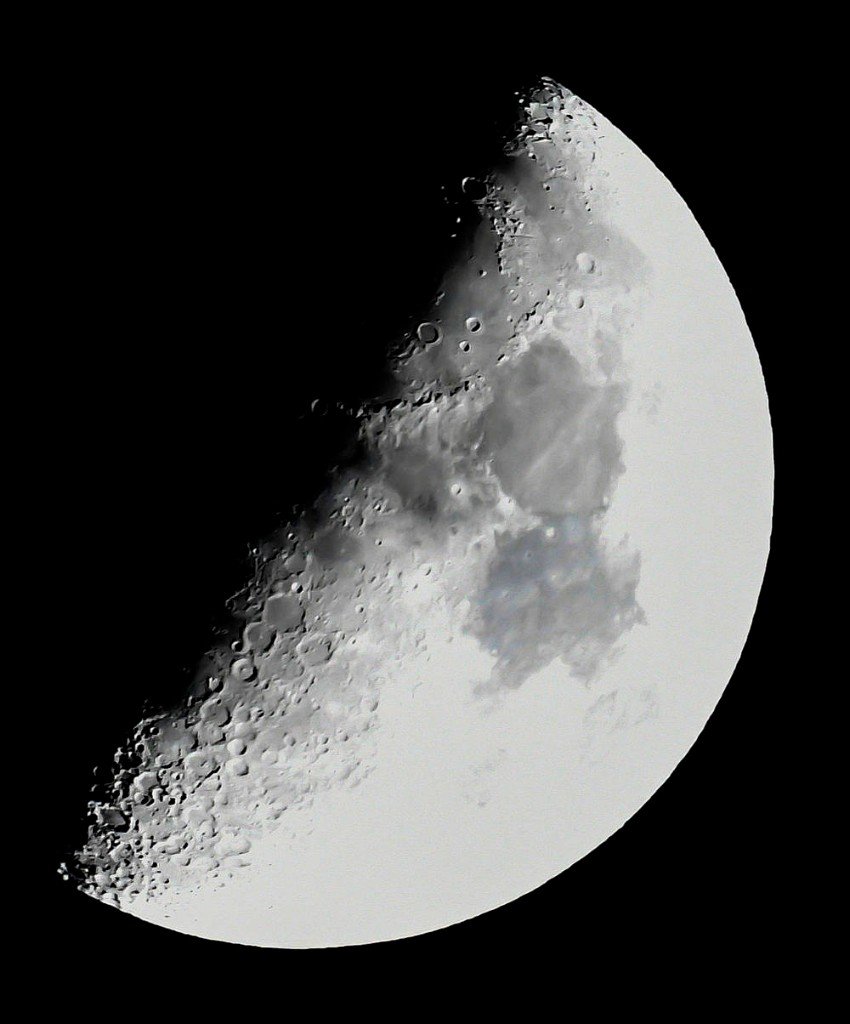
Predicting an eclipse requires solving a complex geometric problem. The Moon's orbit is inclined by about five degrees to the ecliptic, so eclipses can occur only when the Sun, Moon, and Earth align near the lunar nodes — the points where the Moon's orbit crosses the ecliptic plane. The timing of an eclipse depends on the positions of the Sun and Moon, while the path of totality depends on the Moon's distance from Earth (which affects the size of its shadow) and the curvature and rotation of the Earth itself.
In 1824, the German astronomer Friedrich Bessel refined eclipse prediction by introducing a method that projected the Moon's shadow onto an imaginary plane through the Earth's center, then mapped it back onto the surface. This “Besselian” approach, combined with Newtonian mechanics and increasingly accurate lunar tables, allowed astronomers to calculate eclipse paths with unprecedented precision.
Modern mastery
Today, eclipse prediction is a triumph of computational astronomy. Modern models account for the Earth's non-spherical shape, tidal forces, and even subtle changes in the Earth's rotation. The timing of the total eclipse on April 8, 2024, for example, was known to within a second, thousands of years after fearful humans first began trying to anticipate these events.
NASA and other agencies publish detailed maps and tables for thousands of years of eclipses, available online for anyone to consult. These maps show not only the path of totality but also the timing of partial phases, the duration of totality at any point, and the altitude of the Sun above the horizon.
Milestones in mapped prediction
The journey from ancient eclipse cycles to modern predictive maps is a story of human curiosity and ingenuity. It began with the patient accumulation of observations and the search for patterns, evolved through the development of mathematical models and projection methods, and culminated in the precise computational tools of today. The first mapped eclipses of the 17th and early 18th centuries — by Weigel, Cassini, and especially Halley — stand as milestones in this journey, marking the moment when eclipse prediction became not just an art, but a science.