Guide To Eclipses
Beginner guide to solar eclipses: how the Moon's shadow crosses Earth, what totality looks and feels like, why the path on the map matters, and how to plan…
Welcome to Your First Solar Eclipse
If you are new to solar eclipses, you have arrived at the perfect starting point. This page is a friendly, jargon-free introduction to what happens when the Moon slides in front of the Sun, why the narrow “path of totality” on the map is so important, and what you can expect to see and feel when day briefly becomes night.
How the Moon's Shadow Crosses Earth
Lunar vs. solar eclipses
A solar eclipse happens when the Moon passes directly between the Sun and Earth. As it moves, the Moon casts a shadow that sweeps across our planet. This shadow has two parts:
- The umbra — the dark, central cone where the Sun is completely blocked. Only people inside the umbra see a total solar eclipse.
- The penumbra — the lighter, outer shadow where the Sun is only partly covered. Here, observers see a partial eclipse.
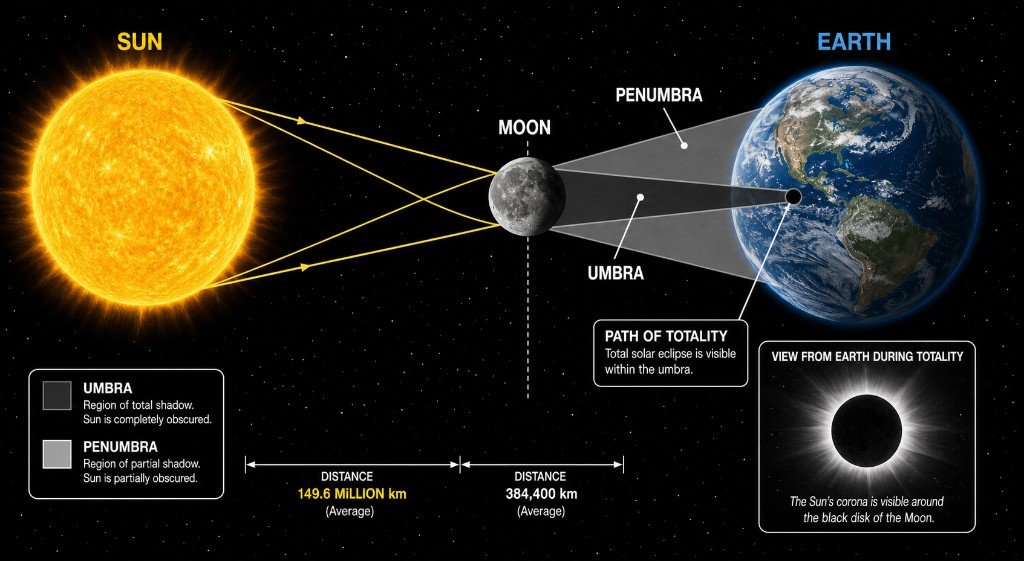
Because the Moon is relatively small compared to Earth, the umbra touches the surface as a narrow strip, often only 100–150 km wide. As Earth rotates and the Moon continues in its orbit, this strip traces a long, thin line across the globe: the path of totality.
What Totality Looks and Feels Like
If you are lucky enough to stand inside the path of totality, the experience is unlike anything else in nature.
- The light changes: It does not fade like sunset. Instead, the sky takes on a strange, metallic quality. Shadows become razor-sharp.
- The temperature drops: Often by several degrees in a matter of minutes.
- Animals react: Birds may settle, insects start their evening calls, and flowers can begin to close.
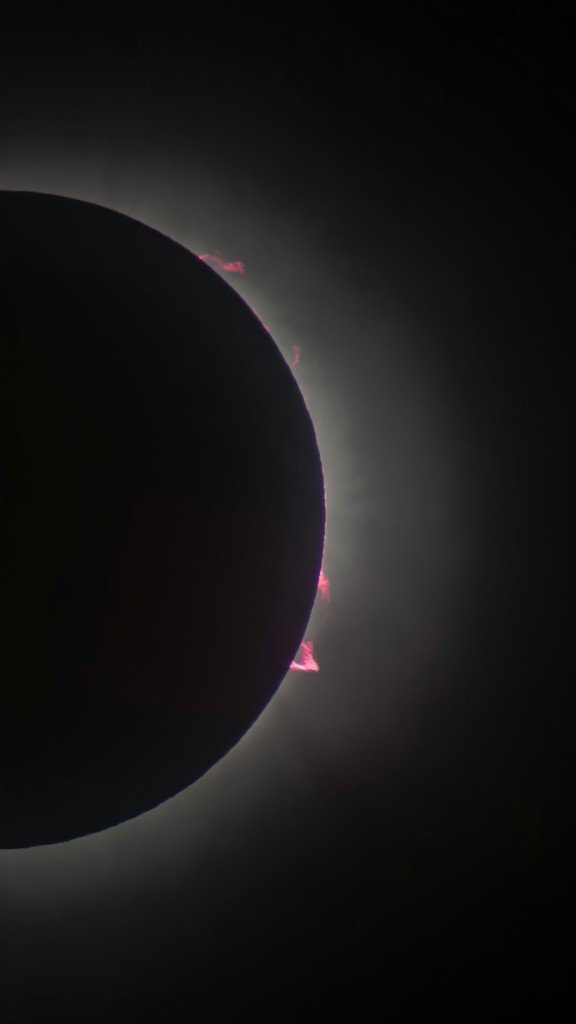
- The sky darkens: Stars and planets appear. The Sun's pearly outer atmosphere — the corona — glows around the black disk of the Moon.
- The emotional impact: Many people describe a sense of awe, humility, or even tears. It is common for crowds to gasp, applaud, or fall silent as totality begins.
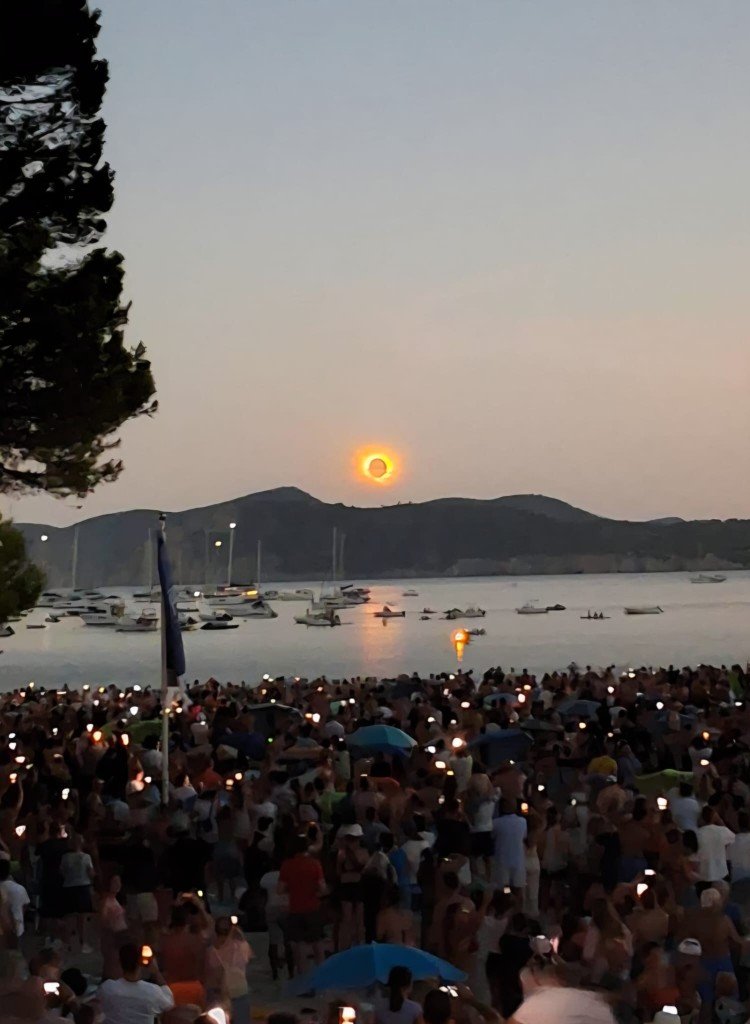
Totality is brief — usually between two and six minutes — but it feels longer. When the first sliver of sunlight reappears (the diamond ring effect), day rushes back almost instantly. For a deeper look at that transformation, see As Day Turns to Night .
Why the Path on the Map Matters
Not all views of an eclipse are equal. If you are outside the path of totality, you will see only a partial eclipse, no matter how large the coverage. The difference is dramatic:
- Inside the path: The Sun is completely covered. You see the corona, the stars at midday, and the full sensory transformation.
- Outside the path: The Sun is never fully covered. The sky remains bright, the corona is invisible, and the “night at noon” effect does not occur.
Partial phases can feel deceptively safe — read A Beautiful Trap to understand why eye protection matters even when the Sun looks dimmed.
This is why eclipse maps are so important. They show:
- The centre line, where totality lasts longest.
- The northern and southern limits, beyond which the eclipse is only partial.
- Major cities, roads, and terrain that can help you choose a practical viewing spot.
When selecting a location, consider
- Duration: Closer to the centre line means more minutes of totality.
- Horizon: A clear view toward the Sun's position is essential, especially if the eclipse is low in the sky.
- Weather: Some regions have statistically better chances of clear skies.
- Access: Roads, parking, and facilities can make a big difference on a busy eclipse day.
Planning Your First Eclipse Trip
For a first-time observer, the key steps are simple:
- Get certified eclipse glasses (ISO 12312-2) for the partial phases. These are essential for eye safety — see Safe Viewing and Eye Protection .
- Plan your day: Arrive early, know where you will stand, and have a backup location in case of clouds. Our Eclipse Chasing guide covers travel and weather backup in more detail.
A Friendly Place to Begin
Solar eclipses can seem technical, with talk of umbra, Saros cycles , and Besselian elements. But at heart, they are simple: the Moon's shadow crosses Earth, and for a few minutes, the rules of day and night are rewritten. This site is designed to help you move from curiosity to confidence — choosing a spot on the map, understanding what you will see, and experiencing your first total solar eclipse safely and memorably.
When you are ready to go further, use the interactive map for local contact times and weather hints, then open deeper guides from the menu above.
Wherever you stand on the map, may your skies be clear and your totality unforgettable.