Eye Protection During Solar Eclipses: A Guide
Professional guide to solar eclipse eye safety: retinal hazard, certified eyewear, filter damage, counterfeit risks, and optical-device filters — guidance…
Why eye protection matters
Solar eclipses are among the most compelling natural phenomena, drawing millions of observers to witness the Moon's passage across the Sun. However, the very allure of an eclipse carries a significant risk: permanent eye damage from improper viewing. Understanding the difference between safe and unsafe eyewear, recognising the limitations of protective equipment, and knowing when to discard compromised gear are essential for anyone planning to observe a solar eclipse. For a broader overview with product links and phase-by-phase rules, see Safe Viewing .
The nature of the hazard
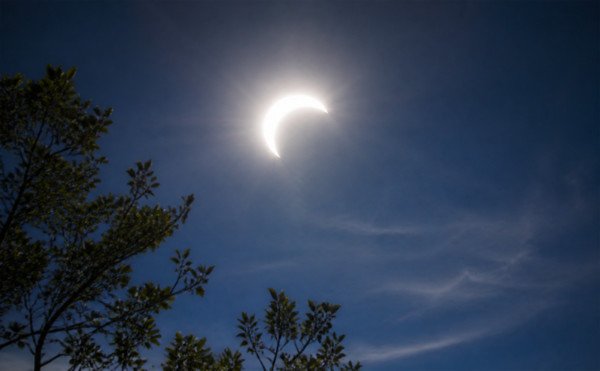
The Sun emits intense visible light, ultraviolet (UV) radiation, and infrared (IR) radiation. Under normal conditions, the human eye instinctively avoids looking directly at the Sun due to discomfort and the aversion reflex. During an eclipse, particularly the partial phases, the Sun's brightness is reduced enough to make direct viewing seem tolerable, but not enough to eliminate the risk. The retina, which lacks pain receptors, can be damaged without the observer realising it. This condition, known as solar retinopathy or “eclipse blindness,” can result in permanent blind spots, distorted vision, or reduced visual acuity.
The danger is greatest during the partial phases of an eclipse, when any exposed portion of the Sun's disk — no matter how small — emits enough radiation to cause injury. The scene above is exactly what makes partial eclipses deceptive: the sky darkens, yet the remaining crescent is still blinding. For why that trap catches so many observers, see A Beautiful Trap . Only during the brief period of totality, when the Moon completely covers the Sun's photosphere, is it safe to view the eclipse with the naked eye — and only from inside the path of totality. The moment any part of the Sun reappears, protective eyewear must be replaced immediately. Timing cues are covered in Baileys Beads Meet the Diamond Ring .
Appropriate eyewear: ISO-certified eclipse glasses
The only safe way to view the partial phases of a solar eclipse is through eyewear that meets the international safety standard ISO 12312-2. This standard specifies strict requirements for optical density, material quality, and durability. Certified eclipse glasses filter out 99.999% of visible light, as well as nearly all UV and IR radiation, reducing the Sun's intensity to a level that is safe for direct viewing.
ISO-certified eclipse glasses are constructed from a special-purpose solar filter material, typically a black polymer or aluminised film, laminated between layers of protective card or plastic. This material is fundamentally different from the tinted lenses used in sunglasses. It is designed to block harmful wavelengths across the entire solar spectrum, not merely to reduce brightness.
Why sunglasses are inadequate and dangerous
Normal sunglasses, even those with very dark lenses, are completely unsuitable for solar observation. They are designed to reduce glare and improve comfort in bright conditions, not to protect against the concentrated intensity of the Sun. Typical sunglasses may reduce visible light by 80–90%, but this is insufficient to prevent retinal damage. More critically, they do not block UV and IR radiation effectively, allowing these invisible wavelengths to reach the retina and cause thermal injury.
The danger is compounded by the fact that sunglasses make the Sun appear dimmer, encouraging prolonged viewing. This increases the total energy absorbed by the retina, raising the risk of burns. Polarised lenses, gradient tints, and photochromic (self-darkening) glasses offer no additional protection and should never be used for eclipse observation.
Potential for damage to protective coatings
Even certified eclipse glasses can become unsafe if the filter material is damaged. The protective coatings and laminations are thin and can be compromised by improper handling, storage, or exposure to heat and moisture. Common forms of damage include:
- Scratches: Deep or extensive scratches can create weak points in the filter, allowing excessive light to pass through. Minor surface marks may not pose a risk, but any scratch that is visible when the glasses are held up to a bright light should be treated with caution.
- Pinholes: Tiny perforations in the filter material can develop from punctures, manufacturing defects, or degradation over time. Pinholes are particularly dangerous because they allow concentrated beams of sunlight to reach the eye, potentially causing immediate injury.
- Delamination: Separation of the filter layers can occur if the glasses are exposed to high temperatures or humidity. This can create bubbles or gaps that compromise the filter's integrity.
- Fading or discolouration: Changes in the colour or opacity of the filter may indicate material degradation and reduced effectiveness.
How to examine eyewear for damage
Before using eclipse glasses, observers should conduct a thorough inspection. Hold the glasses up to a bright light source, such as a lamp or the sky (not the Sun), and examine the filter material carefully. Look for:
- Any visible scratches, especially those that catch the light or appear deep.
- Pinholes or small dots of light passing through the filter.
- Bubbles, wrinkles, or areas where the layers appear to be separating.
- Discolouration or uneven shading across the filter.
If any of these defects are present, the glasses should be discarded immediately. Do not attempt to repair damaged filters with tape, glue, or other materials, as this will not restore their safety.
The need to discard and replace damaged eyewear
Eclipse glasses are not designed for long-term reuse. While they can be used for multiple eclipses if they remain in perfect condition, the risk of undetected damage increases with each use. Observers should replace eclipse glasses if:
- They are more than a few years old, as filter materials can degrade over time.
- They have been stored in adverse conditions (high heat, humidity, direct sunlight).
- They show any signs of damage, as described above.
- They were purchased from an unverified or unreliable source, as counterfeit products are common.
When purchasing eclipse glasses, buyers should ensure that the product is labelled with the ISO 12312-2 standard and comes from a reputable vendor. The American Astronomical Society and other scientific organisations maintain lists of verified suppliers. Glasses without proper certification, or those marketed as “eclipse viewers” without reference to the ISO standard, should be avoided.
Special considerations for optical devices
Eyewear is not the only consideration for safe eclipse observation. Cameras, telescopes, and binoculars require dedicated solar filters that attach to the front aperture of the instrument. These filters must also meet the ISO 12312-2 standard or equivalent specifications for optical density. Filters that screw into the eyepiece of a telescope are dangerous and should never be used, as they can crack or shatter from the concentrated heat of the Sun, causing immediate and severe eye injury.
When using optical devices, the filter must remain in place at all times during the partial phases. Removing the filter, even briefly, can result in instantaneous eye damage. Observers should practise filter removal and replacement before eclipse day to ensure a smooth transition during totality — see Eclipse Photography and Photo Expedition Kit for camera-specific planning.
Eye protection during solar eclipses is not optional; it is a critical safety requirement. ISO-certified eclipse glasses are the only safe option for direct viewing of the partial phases, and they must be inspected carefully before each use. Sunglasses, smoked glass, exposed film, and other improvised filters are inadequate and dangerous. Damaged or compromised eyewear should be discarded without hesitation. By following these guidelines — and verifying them against current official sources — observers can enjoy the spectacle of an eclipse without risking permanent harm to their vision, as described in The Awe and Splendor of Totality when totality arrives safely.